
What Does the Evil Eye Symbol Mean?
The evil eye is one of the most recognizable symbols in jewelry today, but its meaning goes back thousands of years, long before it became a popular motif in modern gold jewelry. If you've ever wondered what the symbol actually represents — or whether it's just a trend — here's the real history behind it.
Where Does the Evil Eye Symbol Come From?
The evil eye (sometimes called "nazar") is believed to have originated in ancient Mesopotamia and spread across the Mediterranean, Middle East, and South Asia over thousands of years. The core belief behind it is simple: a malicious or envious glare from another person — the "evil eye" — can bring misfortune to the person it's directed at, often without the giver even meaning it.
To guard against this, cultures across Greece, Turkey, the Middle East, and beyond began wearing an eye-shaped talisman of their own — the idea being that the symbol reflects or wards off the negative energy before it can take hold.
What Does the Blue Color Mean?
Most evil eye charms are a deep blue, often layered with white and sometimes a darker navy or black center, resembling an eye. Blue was historically a rare and valuable color, associated with the sky, water, and protection. In many cultures, blue eyes themselves were seen as unusual and were thought to be more likely to cast an "evil eye" glance — so the color became tied to the protective symbol itself.
Is the Evil Eye Religious?
The evil eye predates most major religions and isn't tied to one specific faith — it appears in Greek, Turkish, Jewish, Islamic, and Latin American folk traditions, among others, each with its own variation. Today, it's worn more broadly as a symbol of protection and positive intention rather than a strictly religious item, which is part of why it's become so popular in everyday jewelry.
Evil Eye Jewelry Today
Modern evil eye jewelry keeps the symbolism but translates it into fine jewelry materials — solid gold, gemstones, and cubic zirconia in place of the traditional glass beads. It's worn less as a strict protective talisman and more as a meaningful, personal piece — often gifted to someone you want to wish well.
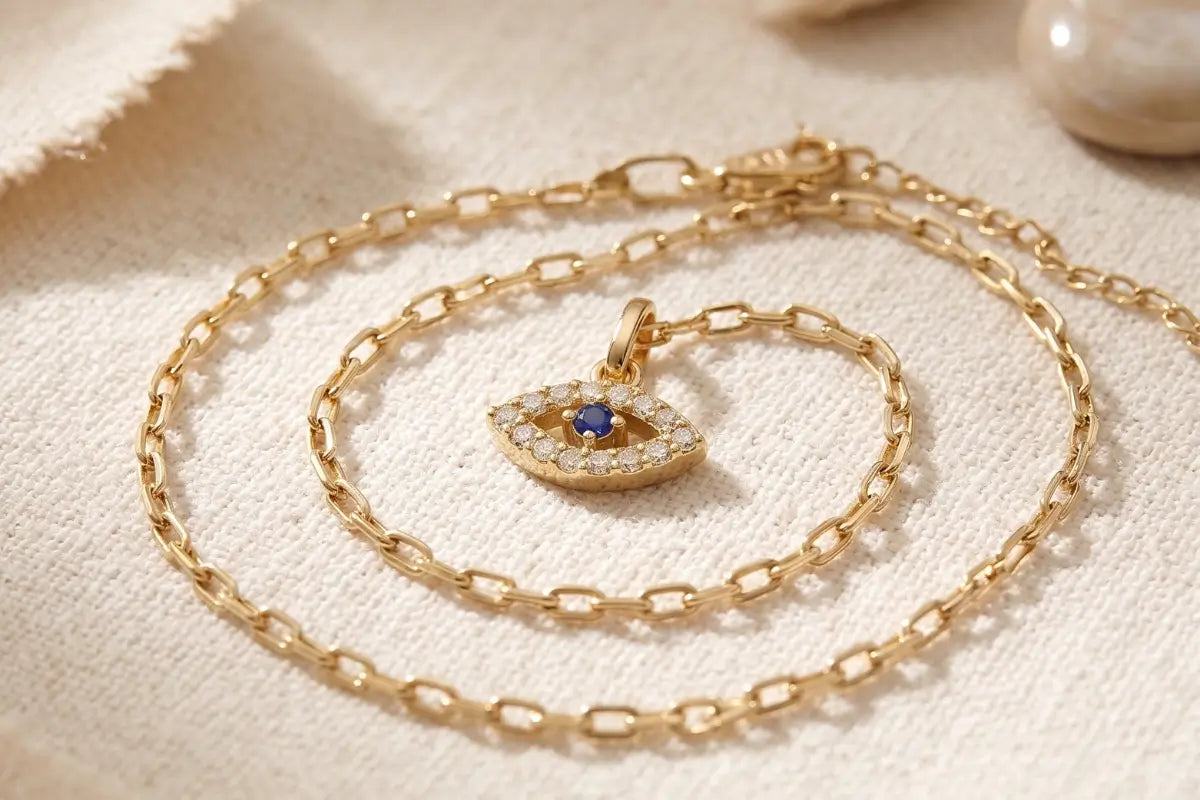
Our Evil Eye Stud Earrings set a lab-grown sapphire at the center, surrounded by CZ detailing, in real 14K solid gold. For a necklace version, our Evil Eye Sapphire Necklace uses the same blue sapphire detailing on a delicate pendant chain.
Frequently Asked Questions
What does wearing an evil eye symbol mean?
Traditionally, it's worn as protection against envy or ill will directed at the wearer. Today, it's also commonly worn simply as a meaningful design choice or a gift symbolizing good wishes.
Is the evil eye good luck or bad luck?
The evil eye itself refers to the harmful glare it protects against — the charm or jewelry piece is the protective symbol, meant to bring good luck and ward off negativity, not represent bad luck itself.
Why is the evil eye always blue?
Blue was historically associated with protection, the sky, and water, and was considered a rare, valuable color — which is why it became the traditional color for evil eye talismans.
Can you gift evil eye jewelry to someone?
Yes — it's actually one of the most common ways evil eye jewelry is given, as a way of wishing someone protection and good fortune.
Explore our full jewelry collection for more symbolic and everyday 14K solid gold pieces.