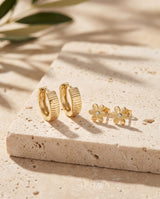
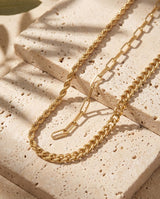
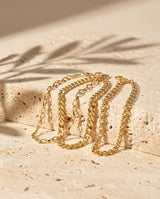
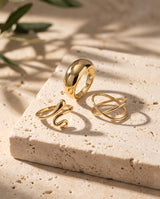
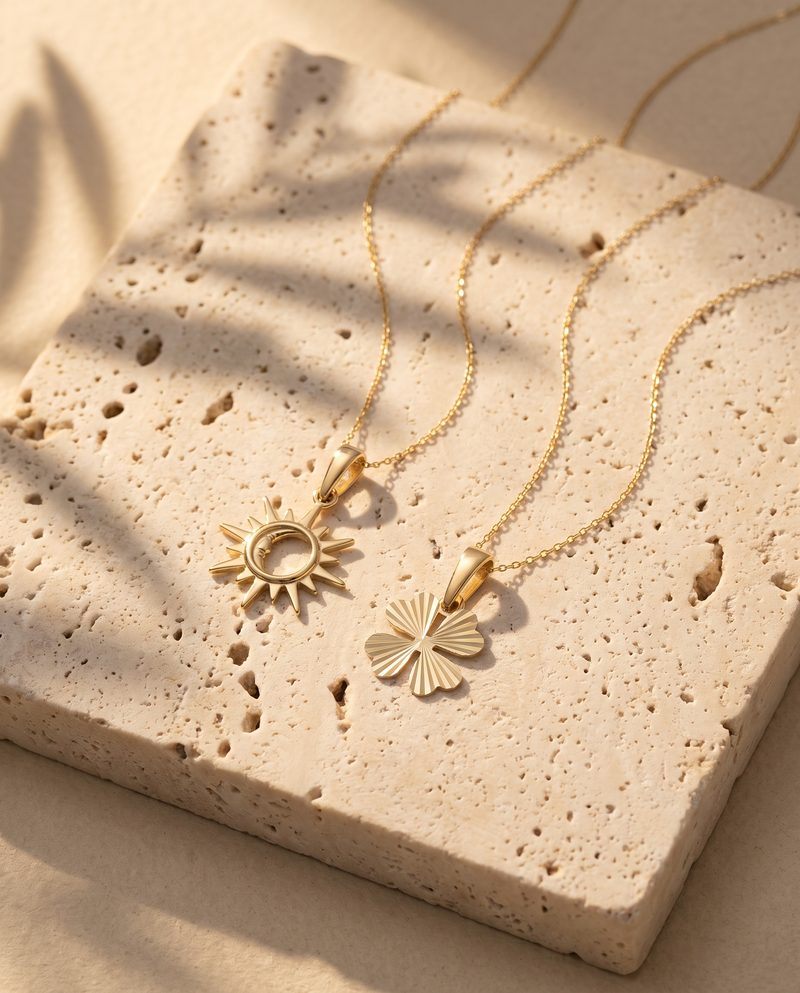
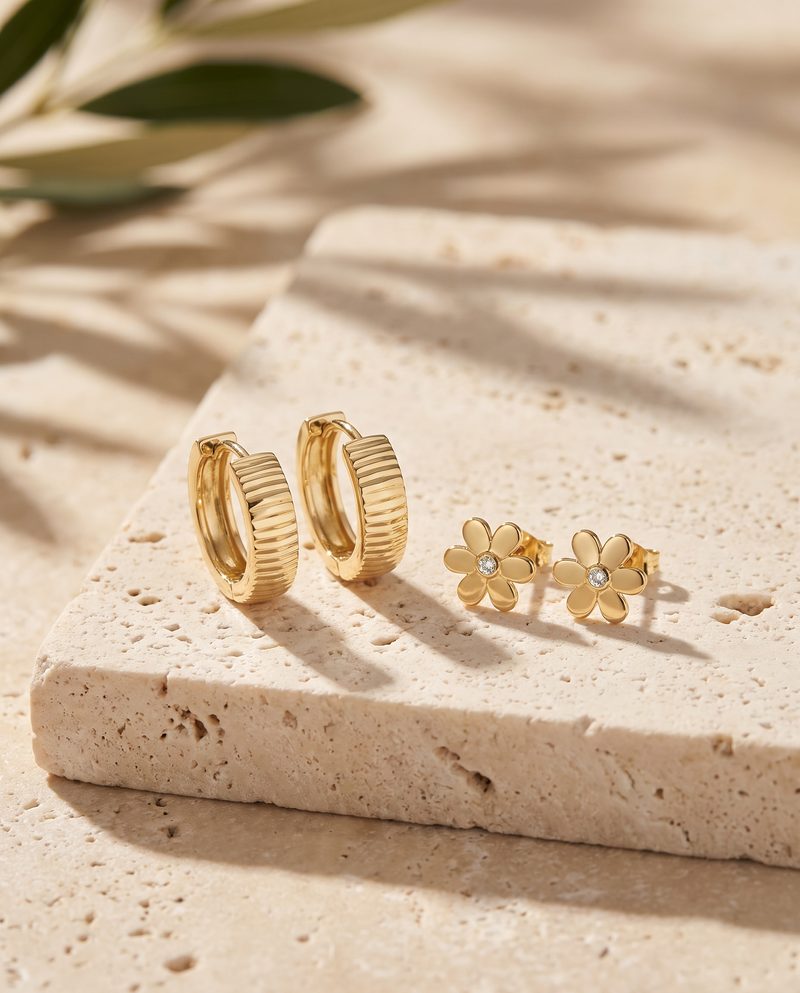
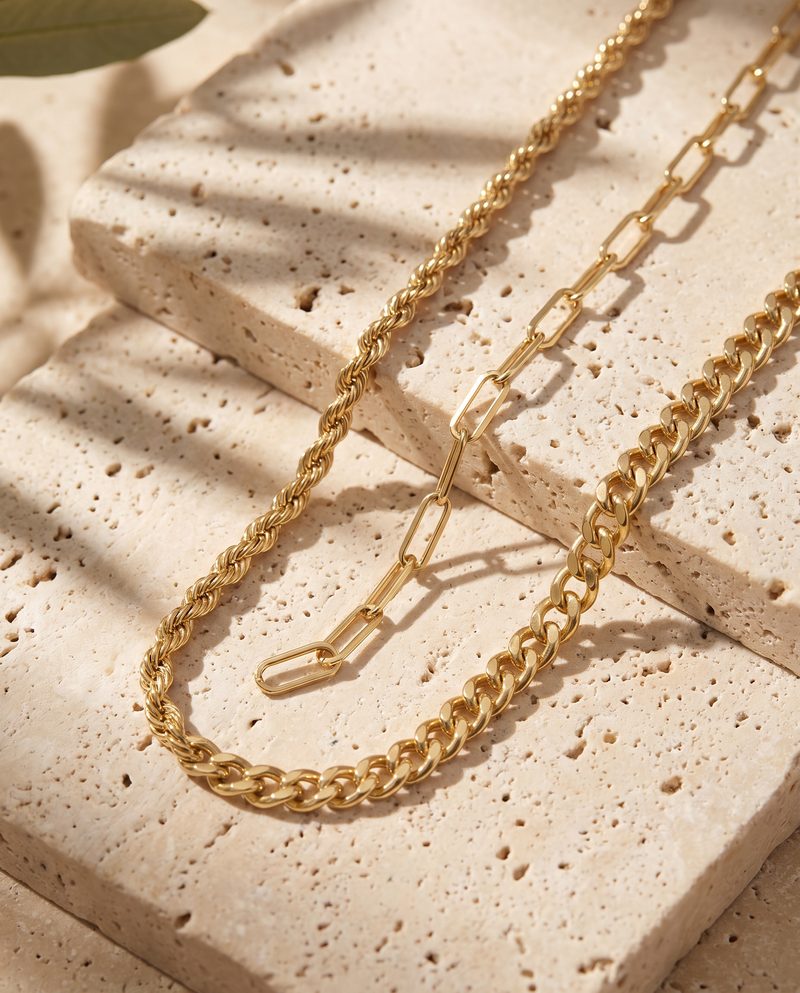
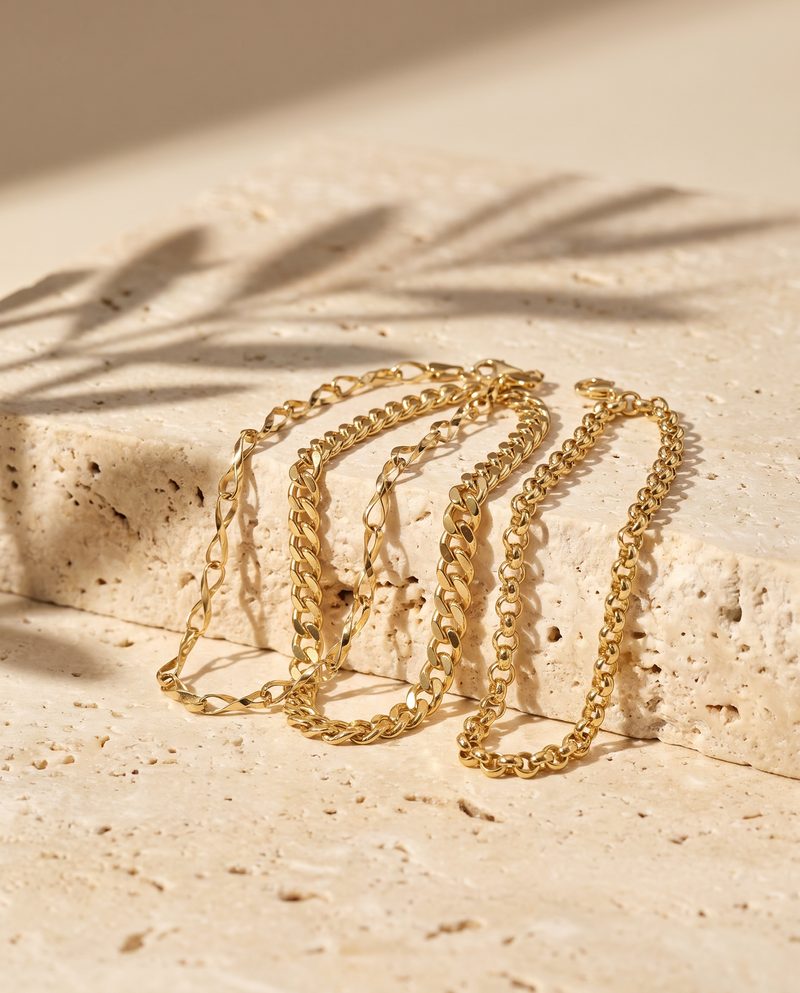
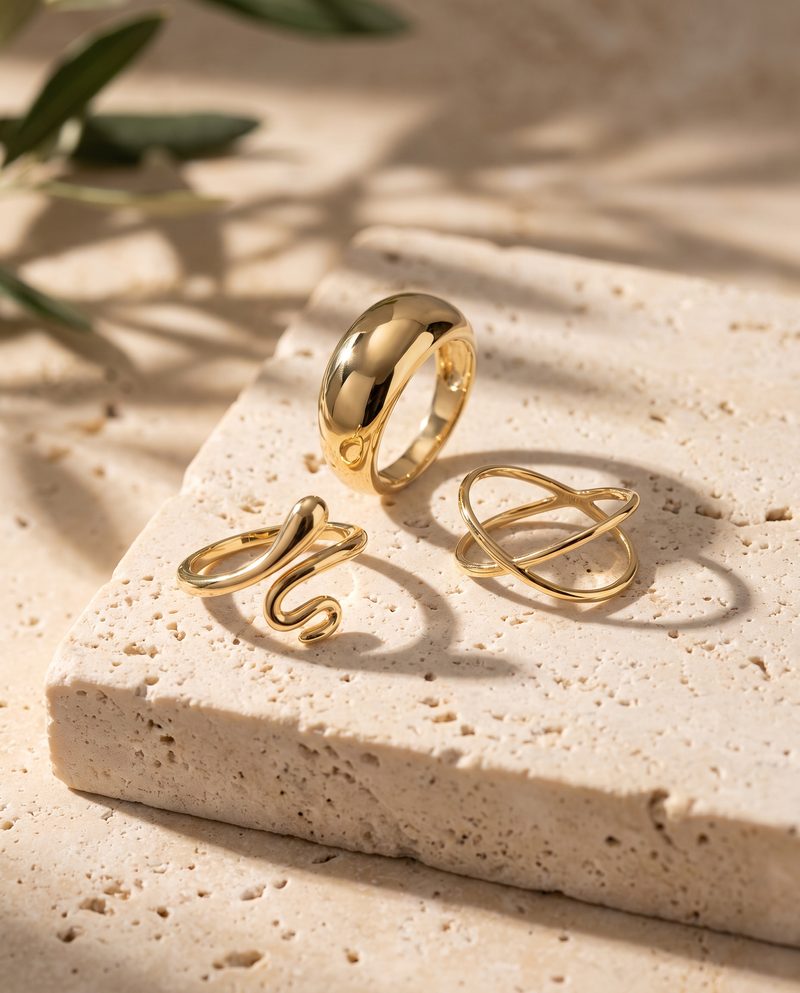
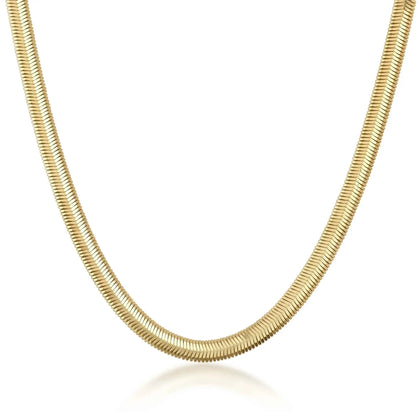
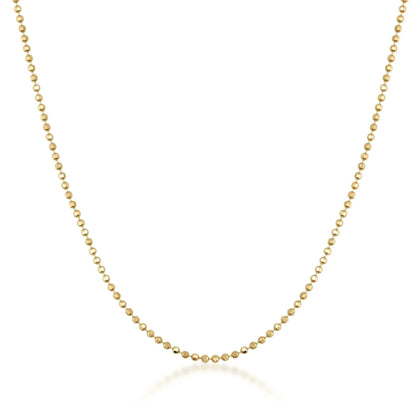
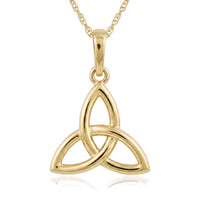
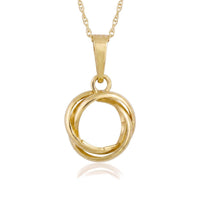
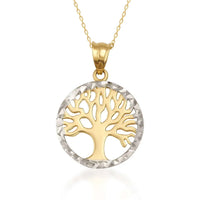
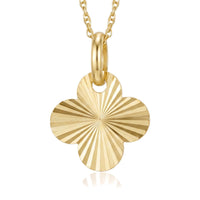
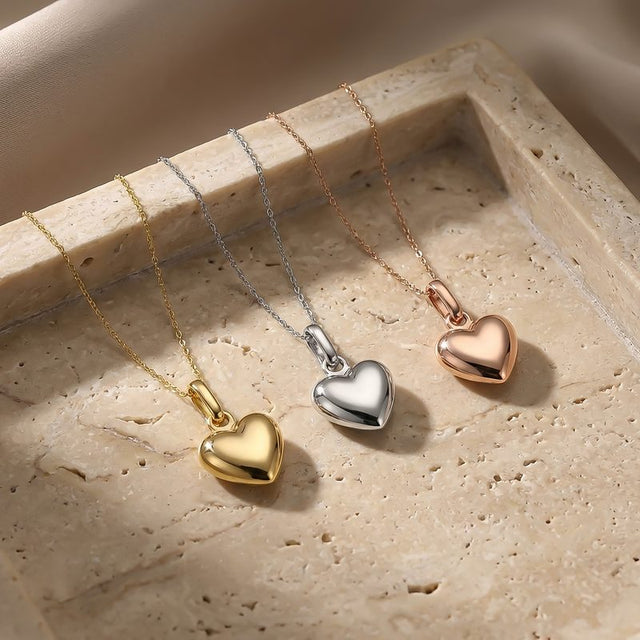
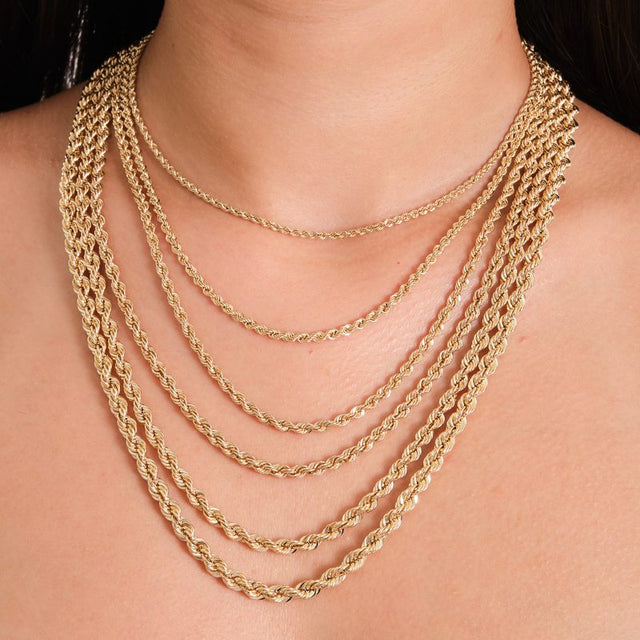
NecklacesSmall symbols of the sun, the sea and the earth.EarringsLight enough to forget, beautiful enough to notice.ChainsEvery end becomes a new beginning.BraceletsA quiet circle around your wrist.RingsSimple forms that grow with you.
Chains
Chains in 14K gold, from fine everyday links to bold statement pieces.
Gold chain for a pendant: the right style, width and length
· 9 min read
The best gold chain for a pendant is a solid cable chain about 1 to 2 mm wide, or a flat curb or belcher (round-link) chain of a similar width: its links let the bail slide freely, and solid links stand up to the daily rub of a pendant. Go finer, 0.65 to 1 mm, for a tiny charm, and wider, 2 to 3 mm, for a large or heavy one. At 18 inches (45.7 cm), most pendants sit right on the collarbone. Here is how to match the two.
In this guide8
What is the best chain for a pendant?
The right chain depends on three things: the size of the pendant, how often you wear it and the look you want around it. Answer three quick questions to find your match.
Which chain suits your pendant?
How big is your pendant?
A small charm, up to about 10 mm
A medium pendant, 10 to 20 mm
A large or heavy pendant, over 20 mm
How will you wear it?
Every day, I rarely take it off
Mostly alone, neat under a collar
In a stack with other chains
What should the chain do?
Disappear, so the pendant is the star
Lie flat and smooth on the skin
Add a modern, open link
Show, as a strong chain in its own right
A diamond-cut cable chain
For most pendants, a solid cable chain of 1 to 1.4 mm is the safest choice. The oval links let the bail glide, the facets add sparkle, and it suits a charm you wear every day.
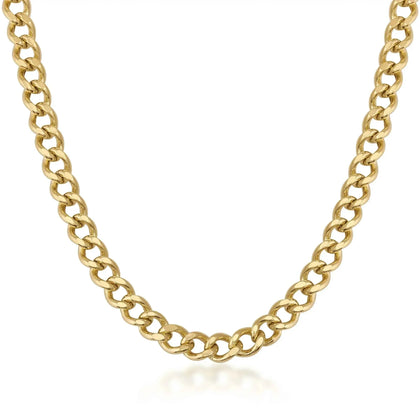
For a small or medium pendant worn on its own, a solid flat curb chain lies smooth on the neck, keeps the pendant facing forward and stays tidy under a shirt collar. Pendant over 20 mm? Choose the belcher chain instead.
For a small charm up to about 10 mm in a layered look, a 1.8 mm paperclip chain adds long, open links that read modern and keep the stack light. Pendant over 20 mm? Choose the belcher chain instead.
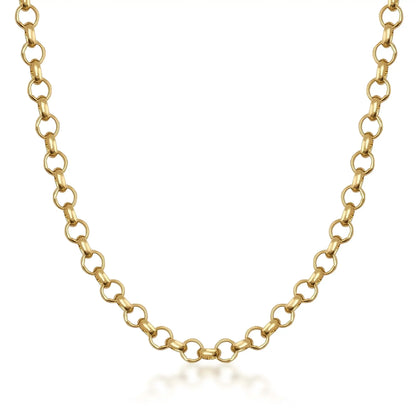
For a larger or heavier pendant, a full solid belcher chain of 2 to 3.2 mm has round, weighty links that carry the load and hold their shape for years.
A good pendant chain has links that let the bail move and do not twist or kink under weight. These styles do that well:
Cable: oval links joined at right angles. The classic pendant chain, because the bail slides over the links without catching. Ours is solid and diamond-cut, from 0.65 to 2 mm.
Rolo and belcher: round links that let a pendant glide and look a touch bolder than cable at the same width. Our rolo chain necklace is semi-hollow and light; for a heavy pendant, choose the belcher, our full solid version at about twice the weight.
Box: square links that make a structured, strong chain, good for larger pendants and men's pendants. Ours is a solid rounded box in 4 or 5 mm.
Flat curb: low links that lie flat, so the pendant sits neatly and faces forward. Ours is solid, from 0.85 to 1.7 mm.
Wheat: twisted oval links braided together. The braided links resist kinking, so a bail rides along the chain without catching.
Paperclip: long links that suit a small, light pendant. The bail can settle into one link, so it moves less freely than on a cable chain.
How thick should a gold chain be to hold a pendant?
Match the chain's width to the pendant's size and weight. The chain should look finer than the pendant but never so fine that it strains. This is the rule of thumb we use:
Pendant
Chain width
Heon chains
Small charm, up to 10 mm
Chain width 0.65 to 1 mm
Heon chains Cable 0.65 to 1 mm, flat curb 0.85 mm
Medium pendant, 10 to 20 mm
Chain width 1 to 1.5 mm
Heon chains Cable 1 or 1.4 mm, flat curb 1.4 mm
Large pendant or stones, over 20 mm
Chain width 1.5 to 3 mm
Heon chains Cable 1.7 or 2 mm, belcher 2 or 2.8 mm
Heavy medallion or men's pendant
Chain width 3 mm and up
Heon chains Belcher 3.2 mm, rounded box 4 or 5 mm
Weight matters as much as width. At 18 inches, our 0.65 mm cable chain weighs 0.70 g and our 2 mm cable weighs 5.10 g, so the 2 mm chain carries far more gold under the bail. On our cable chain, the 0.65 and 0.85 mm widths close with a spring ring; from 1 mm up, a lobster claw.
1 to 2 mmthe chain width that suits most pendants
18 inthe classic pendant length, on the collarbone
Solid linkswear best under a pendant's daily rub
Will a pendant fit on a chain? Check the bail
A pendant hangs from its bail, the small loop at the top, and you slide it on from the clasp end. Before you pair a pendant with a new chain, check three things:
The clasp passes through the bail. The clasp and its end ring are the widest part of most fine chains. If they will not pass, the pendant will not go on.
The bail moves along the links. It should slide, not bind. A bail that catches wears a groove into the same spot.
The proportions look right. A wide chain squeezed through a dainty bail looks crowded, and a hair-fine chain under a big pendant looks strained.
To check a pendant you already own, measure the inside of the bail with a ruler or calipers and compare it with the chain's width and clasp. If the bail is too small, a jeweler can fit a larger bail or jump ring. Please don't pry a closed bail open with pliers: that is how gold bails crack.
Calipers read a bail opening to a tenth of a millimeter, the quickest way to know if a pendant will pass over a clasp.
Which chains are not good for pendants?
Herringbone and snake chains. Their smooth, flat plates are beautiful alone, but a bail rubbing in one place can scratch them, and the weight of a pendant can kink them.
A very fine chain under a heavy pendant. A 0.65 mm chain is perfect for a tiny charm and wrong for a large medallion.
Hollow chains. A pendant wears on the same links every day, and a thin hollow wall dents and wears through faster. Our guide to solid vs. hollow gold chains explains why we only make solid and semi-hollow.
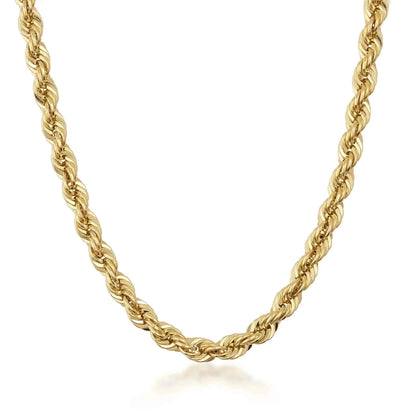
A chunky chain with a tiny pendant. A wide Cuban or rope chain swallows an 8 mm charm, and its clasp often will not pass through a small bail. Let those chains be the statement.
What length chain is best for a pendant?
For most pendants, 18 inches (45.7 cm) is the best length: the pendant rests on the collarbone and shows above most necklines. Choose 16 inches (40.6 cm) for a small charm worn close to the neck, and 20 to 22 inches (50.8 to 55.9 cm) for a larger pendant or to sit over a crew neck. Remember that the pendant adds its own drop: an 8 mm charm and its bail hang a little more than the charm's own height below the chain. Our necklace length guide shows each length on the neck.
To wear a pendant in a stack, give it its own length and keep the chain above it 2 to 4 inches (5 to 10 cm) shorter, so the two don't rest on each other. A textured popcorn chain at 16 inches over a pendant at 18 or 20 inches, or a paperclip chain at 16 inches, is an easy start. Our guide to layering gold necklaces has five stacks to copy.
Sometimes. Many jewelers sell pendants on their own, so check the listing for "pendant only" or a chain length. The three below come both ways: as a pendant only, or on a 14K gold chain from 14 to 22 inches (a 1 mm cable chain on the evil eye, a 1 mm chain on the clover). Pendant only makes sense when you already own a chain you love or want a wider one.
Our symbol pendants are made in 14K gold (58.5% pure gold), stamped 585, never plated or filled, and each ships with a certificate of authenticity:
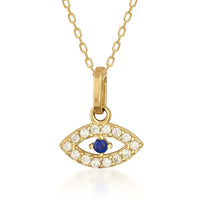
The evil eye necklace, 8.8 mm by 6.6 mm, with a blue lab-grown sapphire framed in cubic zirconia.
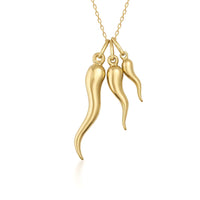
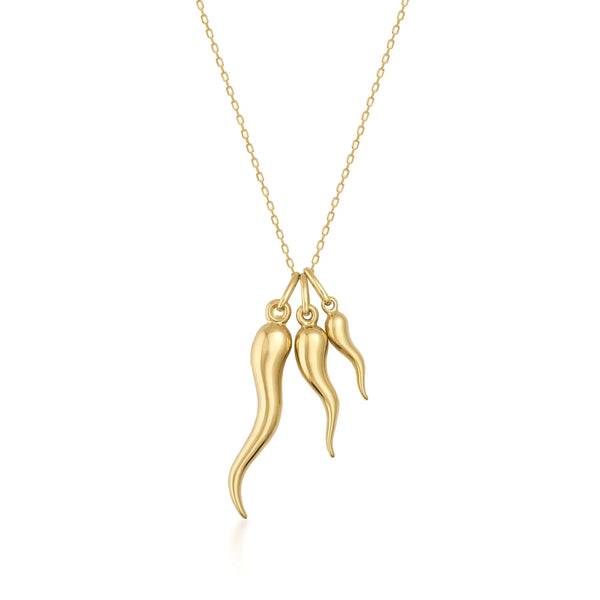
The Italian horn necklace, a curved good-luck horn in small, medium or large, so you can size it to your chain.
You will find more pendants among our symbol jewelry. Shipping is free and insured, and returns are free within 30 days (custom-engraved and personalized pieces are final sale).
No. The bail must be wide enough for the chain's clasp to pass through, and the chain must be strong enough for the pendant's weight. Most small and medium pendants fit a 1 to 1.5 mm cable or curb chain.
What is the difference between a wheat chain and a box chain?
A wheat chain braids twisted oval links into a pattern like an ear of wheat, so it is textured and flexible. A box chain joins square links into a smooth, structured line. Both are strong enough to carry a pendant.
Is a 1 mm chain strong enough for a pendant?
Yes, for a light pendant. A solid 1 mm cable chain with a lobster claw carries a small charm, such as an 8 mm clover, every day. For a pendant over about 20 mm or with large stones, go to 1.5 mm or wider.
Can you put a pendant on a rope or Cuban chain?
Yes, if the bail is large enough to pass over the clasp. These chains suit a bold pendant best, because a small charm gets lost against wide links.
Where can I find a real gold necklace?
Buy from a jeweler that states the karat, the stamp (585 for 14K) and how the chain is made, and lists its weight in grams. Every Heon piece is 14K gold, stamped 585, and ships with a certificate of authenticity.
Should the chain and pendant be the same gold color?
Matching colors is the easy, polished choice, and the same karat helps both wear evenly. Mixing yellow, white and rose gold works too when it looks intentional, for example a white gold pendant on a yellow chain worn with other yellow pieces.